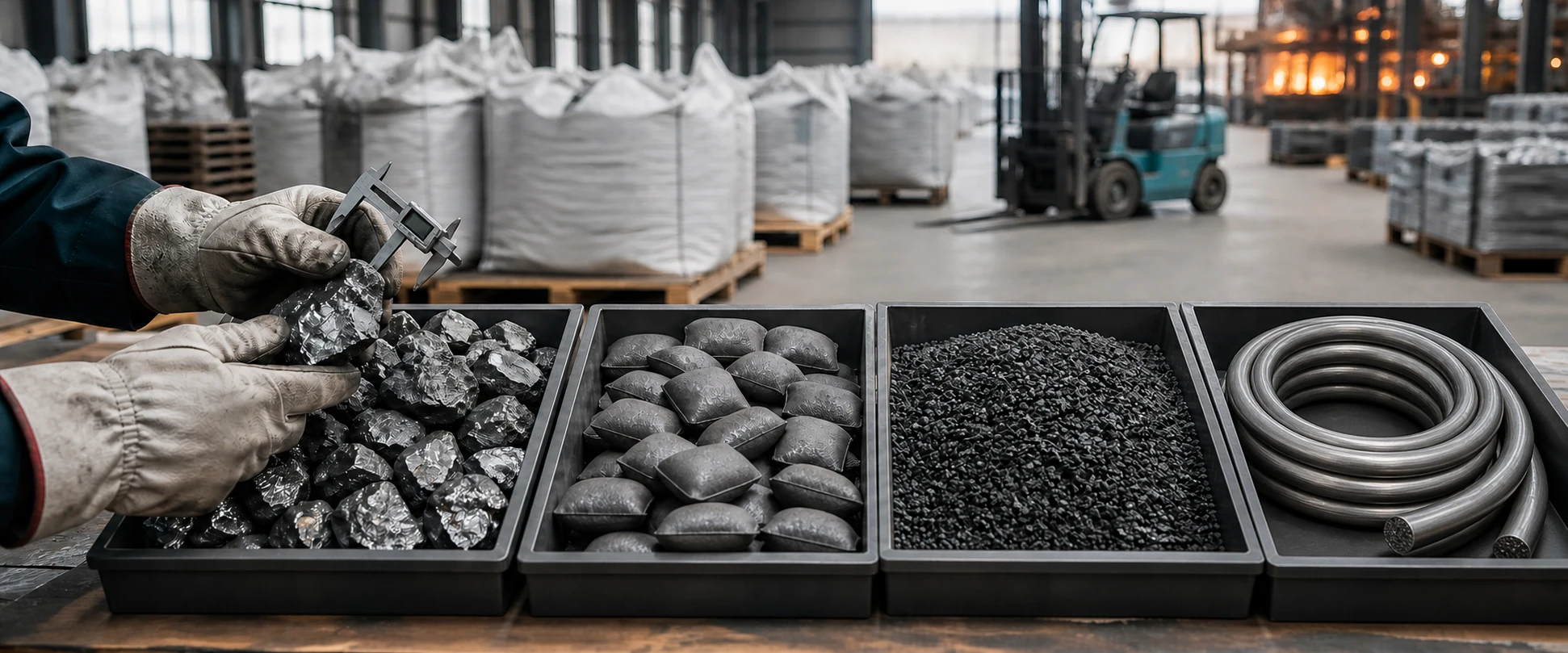
Metallurgical materials matched to steel, foundry and refractory operations
We provide sourcing, stock supply, specification review and delivery follow-up for ferroalloys, carbon materials, inoculants, nodularisers and steelmaking auxiliaries, with separate domestic and export inquiry handling.
Carbon raiser↗Select the final-carbon correction route after tapping or in LFThe carbon raiser is a product-family overview, not a single grade.
Columnar carburizer↗Final-carbon correction after tapping or in LF after grade, residual and dissolution trialsColumnar form identifies shape only; feedstock, strength, residuals and measured carbon recovery require the actual SKU.
Spherical carburizer↗Final-carbon correction after tapping or in LF after grade, residual and dissolution trialsSpherical form identifies shape only; feedstock, strength, residuals and measured carbon recovery require the actual SKU.
Graphitized petroleum coke recarburizer↗Low-impurity final-carbon correction after tapping or in LFConfirm against grade sulfur, nitrogen and ash limits and the steel-sample result.
Calcined petroleum coke recarburizer↗Conditional final-carbon correction after tapping or in LFConfirm against actual CPC lot values and grade impurity limits.
Carbon cored wire↗Fine final-carbon correction after tapping or in LF where wire-feeding facilities exist
Common ferroalloys
Ferrosilicon↗EAF tapping deoxidation and silicon adjustment
Ferromanganese↗EAF tapping manganese adjustment and supporting deoxidation
High-carbon ferromanganese↗EAF melting or tapping Mn adjustment where final-carbon and residual budgets permit
Carbon raiser↗Select the charge, furnace or ladle carbon-correction routeSelect separately from foamy-slag injection carbon.
Columnar carburizer↗Charge carbon or furnace correction after confirming feedstock, residuals, strength and an EAF absorption trialColumnar form identifies shape only; feedstock, strength, residuals and measured carbon recovery require the actual SKU.
Spherical carburizer↗Charge carbon or furnace correction after confirming feedstock, residuals, strength and an EAF absorption trialSpherical form identifies shape only; feedstock, strength, residuals and measured carbon recovery require the actual SKU.
Graphite electrode for electric-arc furnaces↗EAF electrical melting and arc heatingA graphite electrode is an electrically conductive consumable and is not recommended as a steel carbon raiser.
DRI carbon balance and conditional carbon addition
Whether an external carbon source is used must be calculated from actual DRI carbon, residual FeO, gangue, metallization and the final-carbon target.
Carbon raiser↗Select the external charge-carbon or final-carbon-correction routeDo not disregard carbon already contained in the DRI.
Columnar carburizer↗Conditional use after balancing DRI carbon, FeO, gangue, measured formed-product values and a furnace trialColumnar form identifies shape only; feedstock, strength, residuals and measured carbon recovery require the actual SKU.
Spherical carburizer↗Conditional use after balancing DRI carbon, FeO, gangue, measured formed-product values and a furnace trialSpherical form identifies shape only; feedstock, strength, residuals and measured carbon recovery require the actual SKU.
Graphite electrode for electric-arc furnaces↗DRI-EAF electrical melting and arc heatingA graphite electrode is an electrically conductive consumable, not external charge carbon or injection carbon.
Carbon raiser↗Select the LF final-carbon correction route from the steel sample
Columnar carburizer↗Final-carbon correction only where the actual SKU and an LF dissolution trial permitColumnar form identifies shape only; feedstock, strength, residuals and measured carbon recovery require the actual SKU.
Spherical carburizer↗Final-carbon correction only where the actual SKU and an LF dissolution trial permitSpherical form identifies shape only; feedstock, strength, residuals and measured carbon recovery require the actual SKU.
Aluminium deoxidizer for steelmaking↗Aluminium deoxidation after vacuum decarburizationActual forms may include aluminium lumps or granules; confirm against the practice and equipment.
Carbon cored wire↗Fine final-carbon correction after vacuum release or VOD reduction where wire-feeding facilities exist
VOD · Core ferroalloys
Ferrochrome↗Pre-VOD chromium alloying or low-carbon trimming
Ferrosilicon↗Chromium-slag reduction during the VOD reduction stage
VOD · Conditional use
Ferrosilicon is used mainly to recover oxidized chromium in the reduction stage; ferrochrome carbon grade must match the remaining decarburization capacity.
Conditional final-carbon adjustment after AOD tapping
Do not add a carbon raiser directly during AOD oxidative decarburization; carbon introduced by high-carbon ferroalloys belongs to the ferroalloy chemistry balance.
Carbon raiser↗Select the cast-steel EAF charge, furnace or ladle carbon-correction routeSelect separately from foamy-slag injection carbon.
Columnar carburizer↗Charge carbon or furnace correction after confirming feedstock, residuals, strength and a cast-steel EAF trialColumnar describes finished shape; actual carbon source, binder, residuals, strength and recovery require an SKU and furnace trial.
Spherical carburizer↗Charge carbon or furnace correction after confirming feedstock, residuals, strength and a cast-steel EAF trialSpherical describes finished shape; actual carbon source, binder, residuals, strength and recovery require an SKU and furnace trial.
Graphite electrode for electric-arc furnaces↗Cast-steel EAF electrical melting and arc heatingA graphite electrode is an electrically conductive consumable and is not recommended as a steel carbon raiser.
Carbon cored wire↗Fine ladle final-carbon correction from the steel sample where wire-feeding facilities exist
Process media (not catalogue products)
Electricity, electrode arc, oxygen/fuel and stirringControlled by equipment and the approved operating practice
Common chemistry-adjustment materials
Carbon raiser↗Select the induction-furnace charge or melt carbon-correction routeA conventional induction furnace does not inherit EAF foamy-slag injection practice.
Columnar carburizer↗Use in stages to measured charge carbon, final target, feedstock identity, strength and an induction-furnace absorption trialColumnar describes finished shape; actual carbon source, binder, residuals, strength and recovery require an SKU and furnace trial.
Spherical carburizer↗Use in stages to measured charge carbon, final target, feedstock identity, strength and an induction-furnace absorption trialSpherical describes finished shape; actual carbon source, binder, residuals, strength and recovery require an SKU and furnace trial.
Carbon raiser↗Select the ladle final-carbon correction route from the steel sample
Columnar carburizer↗Final-carbon correction only where the actual SKU and a ladle dissolution trial permitColumnar describes finished shape; actual carbon source, binder, residuals, strength and recovery require an SKU and furnace trial.
Spherical carburizer↗Final-carbon correction only where the actual SKU and a ladle dissolution trial permitSpherical describes finished shape; actual carbon source, binder, residuals, strength and recovery require an SKU and furnace trial.
Carbon cored wire↗Fine ladle final-carbon correction where wire-feeding facilities exist
Consumable where LF arc heating is installed (not a carbon raiser)
Graphite electrode for electric-arc furnaces↗Used only in a cast-steel ladle-refining unit actually equipped with LF arc heatingOrdinary ladle metallurgy and the AOD vessel itself do not have this use point.
AOD · Core ferroalloys
Ferrochrome↗Pre-AOD bulk alloying or later low-carbon trimming
Ferrosilicon↗Chromium-slag reduction during AOD reduction
Conditional final-carbon adjustment after AOD tapping
Do not add a carbon raiser directly during AOD oxidative decarburization; carbon introduced by high-carbon ferroalloys belongs to the ferroalloy chemistry balance.
Carbon cored wire↗Fine final-carbon correction after AOD tapping where wire-feeding facilities exist
Carbon material used directly in the cupola
Foundry coke for cupola melting↗Cupola fuel, burden support, reducing-atmosphere source and contributor to the iron carbon balanceSelect foundry coke by size, strength, reactivity, ash, sulfur and moisture; coke breeze cannot replace qualified foundry coke.
Cupola manganese adjustment
High-carbon ferromanganese↗Cupola charge Mn adjustment from charge Mn, S, target matrix and final-carbon budget
Cupola carbon-material boundary
A carbon raiser does not replace foundry cokeThe cupola carbon/sulfur balance is governed jointly by charge, foundry coke and furnace practice; other recarburizing routes require validation at a separate melting or holding node
Induction-furnace charge and iron carbon adjustment
Carbon raiser↗Use in stages to measured charge carbon, final-carbon target, addition timing and bath-stirring conditionsUse as the carbon-raiser route and selection-boundary overview, not as a single grade.
Columnar carburizer↗Use in stages to measured charge carbon, final-carbon target, addition timing and bath-stirring conditionsColumnar is a finished shape only; confirm feedstock, binder, strength, residuals and an induction-furnace absorption trial.
Spherical carburizer↗Use in stages to measured charge carbon, final-carbon target, addition timing and bath-stirring conditionsSpherical is a finished shape only; confirm feedstock, binder, strength, residuals and an induction-furnace absorption trial.
Graphitized petroleum coke recarburizer↗Use in stages to measured charge carbon, final-carbon target, addition timing and bath-stirring conditionsConfirm against base-iron sulfur, nitrogen and ash limits and an absorption trial.
Calcined petroleum coke recarburizer↗Use in stages to measured charge carbon, final-carbon target, addition timing and bath-stirring conditionsConfirm against actual CPC lot values, charge mix and the final-carbon target.
Calcined anthracite recarburizer↗Use in stages to measured charge carbon, final-carbon target, addition timing and bath-stirring conditionsUse only after ash, volatiles, sulfur, nitrogen and absorption conditions are confirmed by a formal TDS and trial.
Induction-furnace manganese adjustment
High-carbon ferromanganese↗Mn adjustment after balancing pre-addition Mn/C/Si/P/S, returns and target microstructure
Induction-melting process boundary
Do not inherit EAF or cupola carbon materialsA conventional medium-frequency induction furnace does not use EAF foamy-slag injection carbon or graphite electrodes and does not treat foundry coke as its default charge carbon raiser
Cupola stage
Foundry coke for cupola melting↗Used only in the cupola-melting stage of the duplex lineSelect to the cupola burden, blast, melt rate and iron carbon balance.
Induction holding and chemistry-adjustment stage
Carbon raiser↗Carbon correction from iron analysis only in the induction holding or chemistry-adjustment stageUse as the carbon-raiser route and selection-boundary overview, not as a single grade.
Columnar carburizer↗Carbon correction from iron analysis only in the induction holding or chemistry-adjustment stageColumnar is a finished shape only; confirm feedstock, binder, strength, residuals and an induction-furnace absorption trial.
Spherical carburizer↗Carbon correction from iron analysis only in the induction holding or chemistry-adjustment stageSpherical is a finished shape only; confirm feedstock, binder, strength, residuals and an induction-furnace absorption trial.
Graphitized petroleum coke recarburizer↗Carbon correction from iron analysis only in the induction holding or chemistry-adjustment stageConfirm against base-iron sulfur, nitrogen and ash limits and an absorption trial.
Calcined petroleum coke recarburizer↗Carbon correction from iron analysis only in the induction holding or chemistry-adjustment stageConfirm against actual CPC lot values, charge mix and the final-carbon target.
Calcined anthracite recarburizer↗Carbon correction from iron analysis only in the induction holding or chemistry-adjustment stageUse only after ash, volatiles, sulfur, nitrogen and absorption conditions are confirmed by a formal TDS and trial.
Duplex-route manganese adjustment
High-carbon ferromanganese↗Conditional Mn adjustment in the induction or holding stage from cupola-output analysis
Duplex-stage boundary
Every carbon material must identify its use stageDo not merge cupola foundry coke and induction-furnace carbon raisers into one material described as applicable across the whole line
Adjacent upstream base-iron carbon control
These links identify upstream melting materials; they do not indicate direct carbon-raiser addition at the nodularization, compacted-graphite-treatment or inoculation node.
Carbon raiser↗Use only at the upstream melting node to the base-iron carbon target before nodularization, compacted-graphite treatment or inoculationUse as the carbon-raiser route and selection-boundary overview, not as a single grade.
Columnar carburizer↗Use only at the upstream melting node to the base-iron carbon target before nodularization, compacted-graphite treatment or inoculationColumnar is a finished shape only; confirm feedstock, binder, strength, residuals and an induction-furnace absorption trial.
Spherical carburizer↗Use only at the upstream melting node to the base-iron carbon target before nodularization, compacted-graphite treatment or inoculationSpherical is a finished shape only; confirm feedstock, binder, strength, residuals and an induction-furnace absorption trial.
Graphitized petroleum coke recarburizer↗Use only at the upstream melting node to the base-iron carbon target before nodularization, compacted-graphite treatment or inoculationConfirm against base-iron sulfur, nitrogen and ash limits and an absorption trial.
Calcined petroleum coke recarburizer↗Use only at the upstream melting node to the base-iron carbon target before nodularization, compacted-graphite treatment or inoculationConfirm against actual CPC lot values, charge mix and the final-carbon target.
Calcined anthracite recarburizer↗Use only at the upstream melting node to the base-iron carbon target before nodularization, compacted-graphite treatment or inoculationUse only after ash, volatiles, sulfur, nitrogen and absorption conditions are confirmed by a formal TDS and trial.
Molten-iron-treatment boundary
Silicon-magnesium inoculant↗Enter inoculation practice only when Mg level, designed duty and supplier TDS establish a low-Mg specialty inoculantIf the material is actually MgFeSi or RE-Mg-FeSi, select it as a nodulariser instead.
No direct carbon-raiser addition at the treatment nodeA carbon raiser cannot replace a nodularizer, compacted-graphite treatment alloy or inoculant
Graphite morphology is a microstructure outcomeSpheroidal or compacted graphite is not a product mapping for graphite powder added at this node
Covers MgO-C, MgO-CaO-C, alumina-magnesia-carbon and formulation-confirmed alumina-carbon or Al₂O₃-SiC-C functional shapes; metallic powders are not used in every shaped refractory.
Silicon metal powder↗Closed metering and mixing before formingA validated antioxidant addition for a carbon-containing formulation; sizing, surface oxidation, binder, heat treatment and service atmosphere require joint review.
Refractory-grade ferrosilicon powder↗Batching after confirmation of a refractory antioxidant fine-powder gradeOnly a separately specified fine-powder candidate is meant; ordinary steelmaking ferrosilicon lump is not direct refractory powder feed.
Aluminium-silicon alloy powder for refractories (related material)Conditional antioxidant-addition point in a carbon-containing formulationSimilar names, forms or uses do not make products interchangeable; confirm product identity, specification, application process and order documents separately.
Silicon-nitride-bonded silicon-carbide products
An in-situ nitriding route and a route using purchased pre-synthesised silicon nitride powder must remain separate; similar names do not make the feeds interchangeable.
Silicon metal powder↗SiC body batching, forming and precursor stage before nitridingAn in-situ reaction silicon source for forming the Si₃N₄ bond; when the process purchases Si₃N₄ powder directly, silicon-metal demand must not be assumed.
Reaction-bonded and silicon-infiltrated silicon-carbide products
Select powder or granular silicon feed from body carbon, pore network and target residual silicon; aluminium-alloy charging practice must not be copied into silicon infiltration.
Industrial silicon for infiltration↗Controlled molten-silicon or vacuum infiltration of a porous SiC bodyUse only an application grade with specifically confirmed sizing, fines, Fe/Al/Ca and infiltration behaviour.
Silicon metal powder↗Batching or reaction point when a powder silicon source is formally specifiedA powder route requires separate confirmation of full size distribution, dispersion, oxidation, contamination and dust safety; lump/granule specifications do not transfer.
SiAlON-bonded specialty shaped products
Only for a documented in-situ synthesis route; a pre-synthesised SiAlON-powder route does not automatically consume silicon metal.
Silicon metal powder↗Batching, forming and precursor stage for controlled nitridingA candidate silicon source for in-situ SiAlON formation, requiring joint confirmation with the actual aluminium source, oxide system, atmosphere and finished-product trials.
Blast-furnace taphole clay
Taphole clay and trough material have different formulations, installation and acceptance criteria and must not be treated as one generic monolithic.
Nitrided ferrosilicon↗Application-grade addition during dry batching and mixing before extrusionOnly a refractory application grade reviewed for the taphole-clay formulation, Fe-Si-N phases, total N, free Si, sizing and powder safety; steel-grade lump/granule specifications do not transfer.
Silicon metal powder↗Formulation-confirmed closed metering and mixingA conditional antioxidant or reaction silicon source requiring trials and validation of extrusion, heat response and service performance.
Refractory-grade ferrosilicon powder↗Conditional batching after approval of a separate fine-powder specificationUse only when the formal taphole-clay formulation and powder TDS/SDS confirm it; ordinary ferrosilicon lump is outside this point.
Blast-furnace trough castables, ramming and gunning mixes
Carbon-containing systems such as Al₂O₃-SiC-C may use silicon metal or nitrided ferrosilicon, subject to the actual formulation and installation method.
Nitrided ferrosilicon↗Dry-mixing stage before packing after refractory-grade confirmationAccept by total N, Si, Fe, phase, free Si, sizing and moisture, then validate installation and finished performance without cross-formulation claims.
Silicon metal powder↗Closed metering and dry mixing in a carbon-containing formulationA formulation-conditional use, not a default for every trough castable or ordinary low-cement castable.
Refractory-grade ferrosilicon powder↗Conditional point after trial approval of a refractory fine-powder gradeValidate sizing, surface oxidation, formulation and installation system; suitability is not inferred from the FeSi grade name.
Other carbon-containing repair, ramming and gunning systems
There is no ferroalloy required across all such families; show a purchasable application only after a supplier formulation and plant trial are established.
Silicon metal powder↗Conditional antioxidant-addition point confirmed by a formal formulationConfirm binder, carbon content, installation method, temperature, atmosphere, sizing and dust control before trial use.
Refractory-grade ferrosilicon powder↗Batching only when a refractory fine-powder application grade is approvedThis is a separate refractory application-grade RFQ framework; it does not promise stock, fixed addition or performance before approval of an actual SKU and formal TDS/SDS/COA.
Boundary for microsilica, colloidal silica and ceramic silicon feeds
These materials are important to monolithics but are outside this silicon-metal and ferroalloy product scope.
Microsilica / silica fumeFine-particle packing and rheology system in LCC, ULCC and NCC castablesSimilar names, forms or uses do not make products interchangeable; confirm product identity, specification, application process and order documents separately.
Colloidal silica, SiC and Si₃N₄Inorganic bonding, aggregate/fine feed or pre-synthesised ceramic-phase pointEach has a separate material identity and cannot borrow the silicon-metal, silicon-carbon-alloy or nitrided-ferrosilicon detail page.
02
Find Products by Product Family
Search by standard name, English name, product code, grade or common term.
This section presents only verifiable cooperation and delivery records; cases without customer authorization are not published, and illustrative images are not presented as customer cases.
Send the operating conditions for human review
Prepare these operating conditions for a more precise technical response
Provide the plant type, furnace, material, target indicators, current product and delivery region; we will review the product, specification, available documents and quotation conditions.
JINSHENG METALLURGICAL MATERIALS · QUALITY & DELIVERY ASSURANCEEVIDENCE IS PROVIDED BY PRODUCT AND ORDER
05 · QUALITY & DELIVERY ASSURANCE
How an order is confirmed, tested and delivered
First agree the specification, lot evidence, delivery records and exception contact in the quotation and contract, then execute the order accordingly. Buyers can continue into company, quality, export-document and quality-claim details.
Place the company entity, supply role, contractual responsibility and public contacts on one page so buyers can verify the business without relying on slogans.
Company entity
Anyang Jinsheng Metallurgical Materials Co., Ltd.
Unified social credit code:91410506317415968T
Established:2014-10-29
Registered capital:RMB 2 million (as stated on the business licence)
The registered business scope includes sales of ferroalloys, refractory and metallurgical materials and import/export activities within that scope; the business licence record prevails.
Registered and operating locations
Registered address Room 7026, 7/F, Zone 3, China Life Insurance Building, southwest corner of Zhongzhou Road and Wenfeng Avenue, Long'an District, Anyang, Henan, China
Office address 10/F, Tower A, Guomao Building, Wenfeng District, Anyang, Henan, China
Trace the delivered lot back to the order specification
A result is shown with its product, lot, sampling approach, test method, issuing entity and scope—not as an isolated number.
01Order specification and tolerance
02Lot number and package label
03Sampling, preparation and test method
04COA, TDS and SDS documents
05Release, loading and after-sales link
CORE FIELDS FOR A LOT QUALITY DOCUMENTItems are confirmed by product and order
Item
Result
Unit
Method
Status
Product / grade
Actual lot
—
Contract
Guaranteed item
Chemical composition
Actual report
%
Test method stated
Lot result
Sizing
Actual report
mm
Screening method stated
Lot result
Lot and issue
Lot / date
—
Issuer
Traceable
ASSURANCE DETAILS · 03
EXPORT AND DOCUMENTS
Confirm trade terms before the document scope
The page separates destination information, quotation and contract responsibilities, and the documents that can actually be supplied for each order.
Before quotation
Specification, sizing, quantity and packing
Country, port or domestic delivery point
Incoterms and named place
Payment, inspection, documents and claim terms
Documents confirmed by order
Quotation / pro forma invoice / contract
Commercial invoice and packing list
Agreed lot COA and package labels
Transport or bill-of-lading documents
Conditional documents
Origin, insurance or third-party inspection
Destination-country compliance material
Issuer and delivery timing
Subject to product, country and contract confirmation
ASSURANCE DETAILS · 04
AFTER-SALES AND QUALITY CLAIMS
A clear entrance, lot record and documented conclusion
Responsibility is not assumed before the contract, lot, sample and test method are checked and the immediate impact is controlled.
01 · LOGOrder, product, lot and site impact
02 · CONTROLIsolate related goods and preserve evidence
03 · REVIEWContract, COA, labels and retained sample
04 · RETESTConfirm method, sample and third-party need
05 · CLOSEConclusion, resolution and improvement record
Buyer provides
Order and lot, remaining quantity, labels, site photos, operating conditions, event time and test report.
Jinsheng reviews
Contract terms, dispatched lot, retained sample or retest, method, logistics events and relevant site conditions.
Resolution after complete review
Based on the contract, evidence and retest result, the resolution may include the responsible contact, review progress, resolution basis, written conclusion and follow-up improvement items.