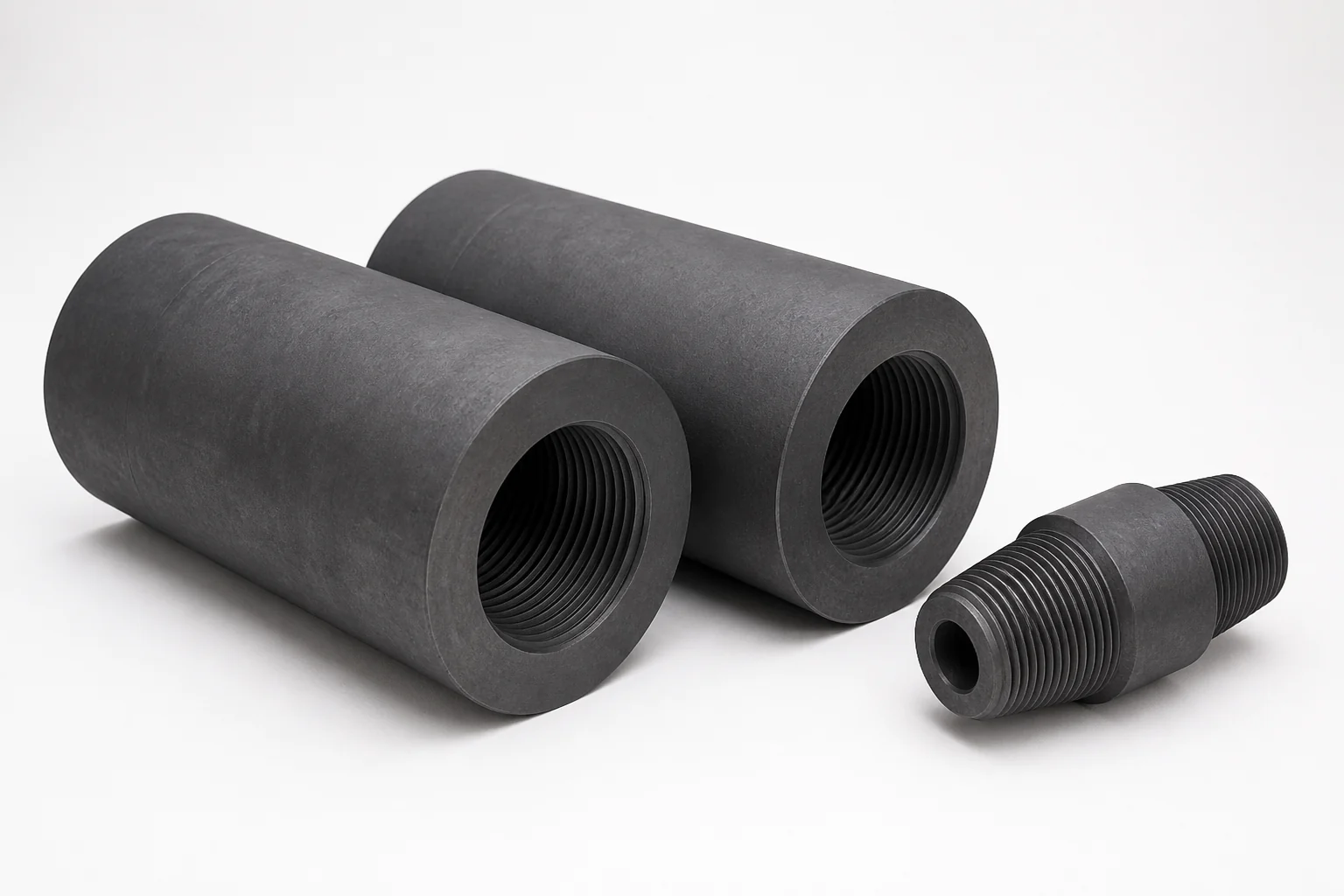
Aliases: EAF graphite electrode · LF graphite electrode · RP / HP / UHP graphite electrode
This page explains the product's principal composition, application directions and inquiry points; confirm the grade, guaranteed indicators, sizing, packing and process fit before quotation.
Arc conduction and heatingEAF scrap meltingLF ladle arc heating
This section supports initial screening; final grade, addition and effects require operating conditions, formal documents and plant validation.
01
What it is
This page explains the product's principal composition, application directions and inquiry points; confirm the grade, guaranteed indicators, sizing, packing and process fit before quotation.
02
What it does
Arc conduction and heating
EAF scrap melting
LF ladle arc heating
03
Where it fits
EAF power-on melting/heating; LF arc heating
EAF melting/heating and LF heating
04
Boundary not to miss
Mismatched power class, size, joint, connection torque, clamping position or current window may cause joint overheating, loosening, breakage, stub loss and arc instability
Oxidation, mechanical impact, thread contamination or moisture can shorten life and increase safety risk
An induction furnace has no arc-electrode use point; do not link it merely because both are electric furnaces
SELECTION BOUNDARY
Start with the selection boundary
Link only to EAF and LF equipped for arc heating—not induction furnaces, cupolas, BOF, RH, VD/VOD, AOD or the casting machine itself. A graphite electrode is a conductive consumable, not bulk recarburizer, injection carbon, carbon cored wire or carbon refractory; traceability of new electrodes and nipples cannot be replaced by electrode scrap.
PRODUCT MANUFACTURING
Manufacturing process and identity boundary
A general graphite-electrode route includes crushing/sieving coke such as needle coke, metered mixing with binder pitch and extrusion, controlled baking, required pitch impregnation and rebaking, high-temperature graphitization, then precision machining and property/visual inspection of electrode body and nipple. Feeds, process cycles and parameters belong to the actual producer and do not represent a Jinsheng-owned line.
01Verify needle coke/other coke, binder pitch and additive identity and lot
02Crush/sieve, proportion size fractions, hot-mix and extrude
03Bake under control and impregnate/rebake as required by the product
04Graphitize at high temperature while controlling resistivity, thermal expansion and structural uniformity
05Precision-machine body/nipple, complete supplier dimensional, property, ultrasonic/visual checks and pack
SPECIFICATIONS & PACKAGING
Grades, RFQ parameters, indicators and documents
The RFQ must start from EAF/LF, AC/DC, transformer and actual current to set RP/HP/UHP class, diameter, length, tolerances, nipple/taper/thread and preassembly, then agree bulk density, resistivity, flexural strength, elastic modulus, coefficient of thermal expansion, ash, oxidation behaviour and allowable loading. All values are governed by the formal TDS, drawing, contract and lot inspection.
01Confirm EAF or LF, AC/DC, transformer, current, holder and mast system
02Match RP/HP/UHP, diameter, length, tolerances and equipment current-density window
03Fix nipple, taper, thread, preassembly, torque/connection method and interchangeability boundary
04Agree density, resistivity, strength, modulus, CTE, ash and oxidation-related indicators/methods
05Reconcile equipment drawing, supplier TDS/SDS, lot report, identity and transport protection
GRADES & SPECIFICATIONS
Grades, specifications, indicators and packaging
Supply specifications, packaging, lead time and quality documents are subject to the formal quotation and order confirmation.
Grade / family
Chemistry
Size and form
Packaging
Specification direction 01Graphite electrode for electric-arc furnacesConfirm grade, applicable standard and guaranteed values before quotation
Power class / standard / manufacturing routeConfirm in inquiry
Bulk density / resistivity / flexural strength / elastic modulusConfirm in inquiry
CTE / ash / oxidation / allowable loadConfirm in inquiry
Confirm against the addition method, equipment and order requirements
Confirm pack format, net weight and labels in the quotation and order
ORDER SPECIFICATION CONFIRMATION
What must be confirmed before this becomes an order specification
Supply specifications, packaging, lead time and quality documents are subject to the formal quotation and order confirmation.
01Confirm the product, grade, application and supply scope
02Fix guaranteed chemistry, sizing, form and packing in the quotation and order
03Agree sampling, test methods, acceptance rules and lot COA fields
04Confirm the required TDS, SDS/PSI, labels and delivery documents
SELECTION AND COMPARISON
Compare specification directions by indicators and operating conditions
Supply specifications, packaging, lead time and quality documents are subject to the formal quotation and order confirmation.
01Specification direction
Graphite electrode for electric-arc furnaces
Compare the key indicators below, then confirm grade, guaranteed values, sizing and packing against the operating conditions.
Key indicators
Power class / standard / manufacturing route · Diameter / length / tolerances / nipple / thread · Bulk density / resistivity / flexural strength / elastic modulus · CTE / ash / oxidation / allowable load
Size and form
Confirm against the addition method, equipment and order requirements
Packaging
Confirm in the quotation and order
INDUSTRY APPLICATION
Industry, furnace, material and addition point
Confirm the process position before method and quantity calculations; an application relationship for one furnace or material must not be copied to another.
01
Steelmaking plants
EAF power-on melting/heating; LF arc heating
Furnace / equipment
AC or DC EAF; LF equipped for arc heating
Material / output
EAF steel melt and LF-refined steel
02
Steel foundries
EAF melting/heating and LF heating
Furnace / equipment
Steel-foundry EAF and ladle-refining units equipped with LF arc heating
Material / output
Cast steel melted in EAF or heated in LF
APPLICATION METHOD
Application, calculation, effect and risk validation
Graphite electrodes serve EAF scrap melting/heating and LF equipped with arc heating—not induction furnaces, cupolas, BOF, RH, VD/VOD, AOD or the casting machine. They are electrical consumables, not additions calculated by a recarburizer equation; selection and consumption must come from the equipment window, supplier manual and furnace records.
01Check equipment, power program, electrode/nipple lot, appearance, ends and threads
02Clean and connect under the supplier manual and record each joint
03Install with dedicated lifting gear, clamp in the permitted zone and avoid mechanical impact
04Control current, arc length, mast, oxygen/burners and cooling within the equipment window; observe joint heat and arc stability
05Record tip loss, side oxidation, breakage, stubs and heat rhythm to establish furnace-specific consumption and stop criteria
PROBLEM AND SOLUTION
From operating objective to effect verification
Each application explains the role, method, quantity principle and risk boundary; the final proposal is confirmed against operating conditions and lot documents.
01
Steelmaking plants
EAF power-on melting/heating; LF arc heating
Furnace / equipment
AC or DC EAF; LF equipped for arc heating
Material / output
EAF steel melt and LF-refined steel
Method
Match power class, diameter, length, joint and loading window jointly with equipment, electrical and supplier teams; inspect, connect, clamp and regulate current/arc length under the manual while recording breakage and oxidation.
Quantity determination
Graphite electrodes are electrical consumables, not chemical additions calculated by a recarburizer equation or fixed kg/t. Select from furnace, transformer/current, power program, diameter/current density, tap rhythm, oxygen/burner practice and holder system; consumption budgets must come from the furnace's own history, jointing records, tip/side oxidation, breakage and stub data, with no fixed cross-plant consumption published.
Expected effects
Forms and maintains the arc needed for melting and heating
Supports stable power input and heat rhythm when correctly matched
Limits and risks
Mismatched power class, size, joint, connection torque, clamping position or current window may cause joint overheating, loosening, breakage, stub loss and arc instability
Oxidation, mechanical impact, thread contamination or moisture can shorten life and increase safety risk
02
Steel foundries
EAF melting/heating and LF heating
Furnace / equipment
Steel-foundry EAF and ladle-refining units equipped with LF arc heating
Material / output
Cast steel melted in EAF or heated in LF
Method
Select electrode and joint from the equipment design and actual operating current, with rules for receipt inspection, storage, connection, clamping, power-on and abnormal shutdown.
Quantity determination
Manage from equipment and furnace-specific consumption history; do not convert it to a melt-recarburizer dose or infer steel carbon recovery from electrode consumption.
Expected effects
Provides the conductive path for cast-steel arc melting or LF heating
Limits and risks
An induction furnace has no arc-electrode use point; do not link it merely because both are electric furnaces
STORAGE & SAFETY
Storage, handling and risk
Follow the supplier manual to protect against rain and impact and protect threads, ends and nipples; use dedicated lifting gear and do not damage the body with bare wire rope.
Connection, clamping and power-on involve high voltage, heat and heavy loads; apply lockout/tagout, lifting and furnace-front safety rules.
This section does not replace the company's final SDS/PSI or the plant safety procedure.
REFERENCE AND ORDER BOUNDARY
Use industry references to understand, then order documents to confirm
Supply specifications, packaging, lead time and quality documents are subject to the formal quotation and order confirmation.
DOCUMENTS & MEDIA
Images, TDS, SDS and COA
Document availability depends on the product, lot, destination market and order agreement.
TDS
Confirms product identity, guaranteed indicators, sizing, form and packing.
SDS / PSI
Confirms storage, handling, protection and market-specific safety information.
COA
Links a specific lot to test items, results, methods and issue information.
INDUSTRY TECHNICAL REFERENCES
Selected external reference material
The following items come from licensed public media or original producer websites and explain similar products or typical processes only. They are not Jinsheng photographs, TDS, SDS or lot COA and create no supply commitment.
Blank COA template
COA field template (not a certificate)
A blank structure for lot, chemistry, sizing, method, disposition and issue data. It contains no test result and cannot be used for delivery.
Public sources supplement general facts; they do not replace Jinsheng's formal product specification, TDS or lot COA.
INQUIRY PREPARATION
Prepare these operating conditions for a more precise technical response
Please provide the specification, quantity, destination, and contact information.
Already includedEC-GRAPHITE-ELECTRODEGraphite electrode for electric-arc furnaces
01Target industry, steel grade or casting material
02Furnace type, equipment, melt weight and current operating practice
03Measured chemistry, target chemistry and permitted residuals
04Planned addition point, temperature, slag and stirring conditions
05Current product, addition, recovery or operating-issue record
06Required size, form, packaging, quantity and destination
07Available melt analysis, microscopy, photographs or trial results
TECHNICAL AND QUOTATION CONSULTATION
Send the operating conditions for human review
Domestic inquiries are handled by the Domestic Sales Department and international inquiries by the International Sales Department. Price, availability and lead time are confirmed for each inquiry based on specification, quantity and delivery location.
Graphite electrode for electric-arc furnaces|Jinsheng Metallurgical Materials Supply Chain Platform