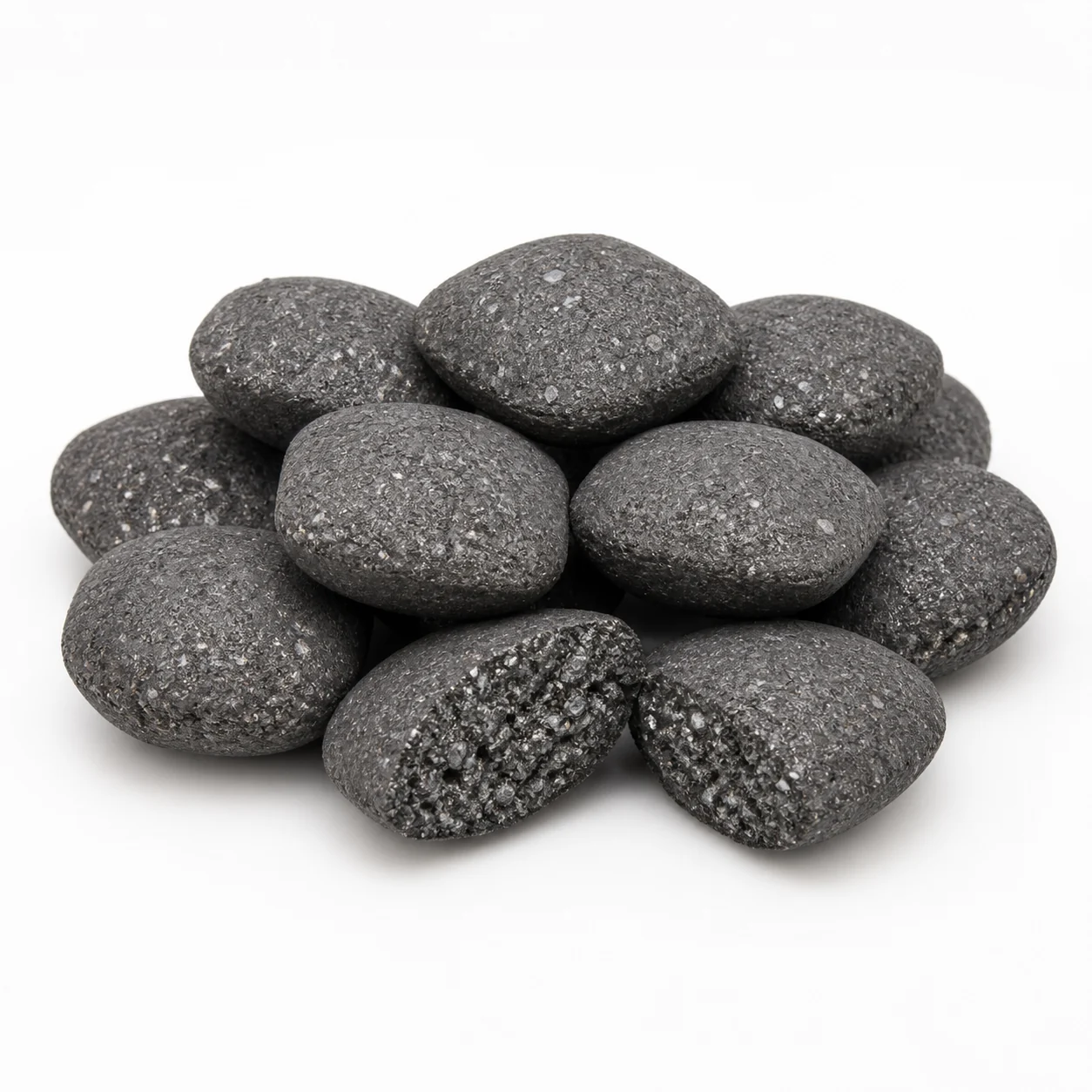
A steelmaking silicon source made principally from verified ferrosilicon fines by batching, binding, briquetting and curing or drying. After finished-product chemistry, effective silicon, moisture, strength and plant recovery are validated, it may be used for tapping deoxidation, silicon alloying and selected slag-reduction duties; it is not silicon-slag briquette, silicon-carbon briquette or lump ferrosilicon.
Tapping deoxidationSilicon adjustment and alloyingProcess-validated slag reductionAgglomeration and use of ferrosilicon fines
Key indicatorsEffective / metallic Si · Total Si / Fe · Al / C / P / S / Ca / Mn / Cr / Ti · SiO₂ / SiC / ash / Na / K / F
Order boundaryQuotation and order confirmation
QUICK DECISION
Four answers before reading the technical detail
This section supports initial screening; final grade, addition and effects require operating conditions, formal documents and plant validation.
01
What it is
A steelmaking silicon source made principally from verified ferrosilicon fines by batching, binding, briquetting and curing or drying. After finished-product chemistry, effective silicon, moisture, strength and plant recovery are validated, it may be used for tapping deoxidation, silicon alloying and selected slag-reduction duties; it is not silicon-slag briquette, silicon-carbon briquette or lump ferrosilicon.
02
What it does
Tapping deoxidation
Silicon adjustment and alloying
Process-validated slag reduction
Agglomeration and use of ferrosilicon fines
03
Where it fits
Preferably added into the tapping stream after slag control or when the ladle contains about one-quarter to one-third of its steel; LF requires adequate dissolution time and a suitable low-oxidising slag
Post-melt chemistry correction or tapping-stream/ladle addition
04
Boundary not to miss
Oxidising slag, moisture, fines, binder dilution or residual carry-in can reduce recovery and affect inclusions, slag and safety
Ultra-low-carbon, electrical, bearing and other high-cleanliness steels require a dedicated low-residual SKU and inclusion-path validation
Moisture, undissolved particles, binder ash and Al/Ca/C/P/S carry-in may cause inclusions or chemistry variation
SELECTION BOUNDARY
Start with the selection boundary
This page covers only a steelmaking ferrosilicon briquette whose principal effective feed is verified ferrosilicon fines. It is not lump/granular ferrosilicon under GB/T 2272, nor silicon-slag briquette, silicon-carbon briquette, high-carbon silicon, silicon-carbide briquette, silicon-metal briquette, FeSi-based cast-iron inoculant or nodulariser. Market formulations may contain silicon metal powder, ferrosilicon slag, silicon-metal slag or different binders. A formal inquiry must confirm feed boundaries, total and effective/metallic Si, SiO₂/SiC, Fe, residuals, binder, moisture, dimensions, strength, fines, TDS, SDS/PSI and lot COA. GB/T 2272 may support the parent-ferrosilicon chemistry reference but is not automatically a complete standard for a bonded briquette.
PRODUCT MANUFACTURING
Product manufacturing process
A typical ferrosilicon briquette uses traceable screened ferrosilicon fines as its principal effective feed. After drying, sizing, homogenisation and chemistry-based batching, an approved binder is metered in, mixed and compacted by roller press or die, followed by curing or controlled drying, cooling, screening and finished-product testing. Published papers and patents provide process windows only and do not represent a Jinsheng production line or fixed formula.
01Confirm fines source, parent FeSi grade, residuals, sizing and moisture
02Pre-dry as required, crush and screen, remove foreign matter and sample at multiple points
03Batch to finished effective-Si and residual targets, then prepare and meter-spray the binder
04Force-mix, roller- or die-briquette, and protect green briquettes with buffered conveying
05Cure naturally or dry under control, cool, remove broken briquettes and recycle fines under a controlled procedure
06Test finished chemistry, moisture, dimensions, compression, drop integrity, fines and storage stability before moisture-protected packing
SPECIFICATIONS & PACKAGING
Grades, specifications, indicators and packaging
Ferrosilicon briquettes have no single dedicated grade table. A complete specification must distinguish total Si from effective/metallic Si and also fix Fe, Al, C, P, S, Ca, Mn, Cr and Ti plus feed- or binder-derived SiO₂, SiC, ash, Na, K, F and moisture. Dimensions, unit mass, compressive and drop strength, fines after transport, bulk density and post-storage strength must map to the same SKU.
01Confirm whether the product is FeSi-fines briquette, silicon-powder blend or slag-bearing composite
02Fix total Si, effective/metallic Si, Fe and grade-sensitive residuals
03Disclose binder type, addition range, ash and finished moisture
04Agree dimensions, unit mass, compression, drop integrity, fines, density and post-storage strength
05Issue the lot COA for the finished briquette rather than the pre-briquetting powder, and review TDS and SDS/PSI
GRADES & SPECIFICATIONS
Grades, specifications, indicators and packaging
Supply specifications, packaging, lead time and quality documents are subject to the formal quotation and order confirmation.
Grade / family
Chemistry
Size and form
Packaging
Specification direction 01Ferrosilicon briquetteConfirm grade, applicable standard and guaranteed values before quotation
Effective / metallic SiConfirm in inquiry
Total Si / FeConfirm in inquiry
Al / C / P / S / Ca / Mn / Cr / TiConfirm in inquiry
SiO₂ / SiC / ash / Na / K / FConfirm in inquiry
Binder / moistureConfirm in inquiry
Confirm against the addition method, equipment and order requirements
Confirm pack format, net weight and labels in the quotation and order
Specification direction 02Ferrosilicon briquetteConfirm grade, applicable standard and guaranteed values before quotation
Si≥70%(外部样本)
Al≤2.0%(外部样本)
C≤2.0%(外部样本)
P / S≤0.02% / ≤0.02%(外部样本)
Ca≤0.20%(外部样本)
Confirm against the addition method, equipment and order requirements
Confirm pack format, net weight and labels in the quotation and order
ORDER SPECIFICATION CONFIRMATION
What must be confirmed before this becomes an order specification
Supply specifications, packaging, lead time and quality documents are subject to the formal quotation and order confirmation.
01Confirm the product, grade, application and supply scope
02Fix guaranteed chemistry, sizing, form and packing in the quotation and order
03Agree sampling, test methods, acceptance rules and lot COA fields
04Confirm the required TDS, SDS/PSI, labels and delivery documents
SELECTION AND COMPARISON
Compare specification directions by indicators and operating conditions
Supply specifications, packaging, lead time and quality documents are subject to the formal quotation and order confirmation.
01Specification direction
Ferrosilicon briquette
Compare the key indicators below, then confirm grade, guaranteed values, sizing and packing against the operating conditions.
Key indicators
Effective / metallic Si · Total Si / Fe · Al / C / P / S / Ca / Mn / Cr / Ti · SiO₂ / SiC / ash / Na / K / F · Binder / moisture
Size and form
Confirm against the addition method, equipment and order requirements
Packaging
Confirm in the quotation and order
02Specification direction
Ferrosilicon briquette
Compare the key indicators below, then confirm grade, guaranteed values, sizing and packing against the operating conditions.
Key indicators
Si · Al · C · P / S · Ca
Size and form
Confirm against the addition method, equipment and order requirements
Packaging
Confirm in the quotation and order
INDUSTRY APPLICATION
Industry, furnace, material and addition point
Confirm the process position before method and quantity calculations; an application relationship for one furnace or material must not be copied to another.
01
Steelmaking plants
Preferably added into the tapping stream after slag control or when the ladle contains about one-quarter to one-third of its steel; LF requires adequate dissolution time and a suitable low-oxidising slag
Furnace / equipment
BOF/EAF tapping ladles and reviewed LF practice; AOD/VOD only in post-decarburisation reduction or final-adjustment stages
Material / output
Steel grades that permit silicon deoxidation or adjustment and have reviewed C, Al, Ca, Ti, P, S and binder carry-in
02
Steel foundries
Post-melt chemistry correction or tapping-stream/ladle addition
Furnace / equipment
Reviewed steel-foundry EAF, induction furnace and tapping ladle
Material / output
Cast steel permitting silicon deoxidation or adjustment with a defined residual budget
APPLICATION METHOD
Application method and effect validation
Dose ferrosilicon briquettes from finished-product effective Si, melt analysis, required net increase and measured furnace recovery, with Si consumed by deoxidation and slag reduction accounted separately; they must not replace lump FeSi on a simple one-for-one mass basis without paired plant trials. Prefer controlled batches into the tapping stream after slag control or when the ladle contains sufficient steel, with permitted stream mixing or argon stirring; LF, AOD and VOD require separate review of slag, decarburisation stage and dissolution time.
01Check grade, furnace, addition point, endpoint oxygen and slag carryover
02Confirm lot effective Si, moisture, strength, fines, binder and sensitive residuals
03Calculate from net Si increase and furnace recovery, separately adding deoxidation or reduction demand
04Add dry briquettes in controlled batches and ensure immersion, dissolution and homogenisation
05Resample and verify Si, oxygen, slag, inclusions, dust and total cost before setting a replacement window
PROBLEM AND SOLUTION
From operating objective to effect verification
Each application explains the role, method, quantity principle and risk boundary; the final proposal is confirmed against operating conditions and lot documents.
01
Steelmaking plants
Preferably added into the tapping stream after slag control or when the ladle contains about one-quarter to one-third of its steel; LF requires adequate dissolution time and a suitable low-oxidising slag
Furnace / equipment
BOF/EAF tapping ladles and reviewed LF practice; AOD/VOD only in post-decarburisation reduction or final-adjustment stages
Material / output
Steel grades that permit silicon deoxidation or adjustment and have reviewed C, Al, Ca, Ti, P, S and binder carry-in
Method
Use dry briquettes only after checking the lot COA, effective silicon, moisture, strength and fines. Calculate from steel grade, endpoint oxygen, initial/target Si, slag carryover and furnace-specific recovery; add in controlled batches with permitted tapping-stream mixing or argon stirring, then resample after complete dissolution and homogenisation.
Quantity determination
For the starting silicon-adjustment estimate use ⟦m_add(kg/t) ≈ 10 × ΔSi ÷ (w_effective-Si × η_Si)⟧, entering ΔSi in percentage points and w_effective-Si and η_Si as decimals; separately account for deoxidation and reduction of FeO, MnO or Cr₂O₃. Do not replace lump FeSi one-for-one by mass without paired plant trials, and no fixed kg/t is published.
Expected effects
Supports steel deoxidation and target-Si adjustment under suitable oxygen and slag conditions
Regular agglomeration can improve metering and reduce dust loss compared with charging loose ferrosilicon powder
Allows economics to be assessed per kilogram of recovered Si after plant validation
Limits and risks
Oxidising slag, moisture, fines, binder dilution or residual carry-in can reduce recovery and affect inclusions, slag and safety
Ultra-low-carbon, electrical, bearing and other high-cleanliness steels require a dedicated low-residual SKU and inclusion-path validation
02
Steel foundries
Post-melt chemistry correction or tapping-stream/ladle addition
Furnace / equipment
Reviewed steel-foundry EAF, induction furnace and tapping ladle
Material / output
Cast steel permitting silicon deoxidation or adjustment with a defined residual budget
Method
Calculate from actual melt analysis, target Si, oxidation state and furnace-specific recovery; use dry accepted briquettes and ensure immersion, dissolution, mixing and resampling. Because induction furnaces have limited refining capability, feed and inclusion control require particular attention.
Quantity determination
Calculate from effective Si and measured furnace recovery; no fixed dose is published across grades.
Expected effects
After validation, supports cast-steel deoxidation, silicon adjustment and regular feeding
Limits and risks
Moisture, undissolved particles, binder ash and Al/Ca/C/P/S carry-in may cause inclusions or chemistry variation
STORAGE & SAFETY
Storage, handling and risk
Keep in original packaging under dry, ventilated indoor storage; isolate any lot with water ingress, abnormal caking, heating or damp briquettes and never charge it directly to molten metal.
Control ferrosilicon fines during production, transfer and charging with dust extraction, grounding, ignition-source control and risk-assessed PPE.
Hydrogen, phosphine or arsine generation with moisture and transport classification depend on the actual formulation and residuals; use the current SKU-specific SDS/PSI and do not infer safety from the trade name or odour.
This section does not replace the company's final SDS/PSI or the plant safety procedure.
REFERENCE AND ORDER BOUNDARY
Use industry references to understand, then order documents to confirm
Supply specifications, packaging, lead time and quality documents are subject to the formal quotation and order confirmation.
DOCUMENTS & MEDIA
Images, TDS, SDS and COA
Document availability depends on the product, lot, destination market and order agreement.
TDS
Confirms product identity, guaranteed indicators, sizing, form and packing.
SDS / PSI
Confirms storage, handling, protection and market-specific safety information.
COA
Links a specific lot to test items, results, methods and issue information.
INDUSTRY TECHNICAL REFERENCES
Selected external reference material
The following items come from licensed public media or original producer websites and explain similar products or typical processes only. They are not Jinsheng photographs, TDS, SDS or lot COA and create no supply commitment.
Blank COA template
COA field template (not a certificate)
A blank structure for lot, chemistry, sizing, method, disposition and issue data. It contains no test result and cannot be used for delivery.
01Target industry, steel grade or casting material
02Furnace type, equipment, melt weight and current operating practice
03Measured chemistry, target chemistry and permitted residuals
04Planned addition point, temperature, slag and stirring conditions
05Current product, addition, recovery or operating-issue record
06Required size, form, packaging, quantity and destination
07Available melt analysis, microscopy, photographs or trial results
TECHNICAL AND QUOTATION CONSULTATION
Send the operating conditions for human review
Domestic inquiries are handled by the Domestic Sales Department and international inquiries by the International Sales Department. Price, availability and lead time are confirmed for each inquiry based on specification, quantity and delivery location.