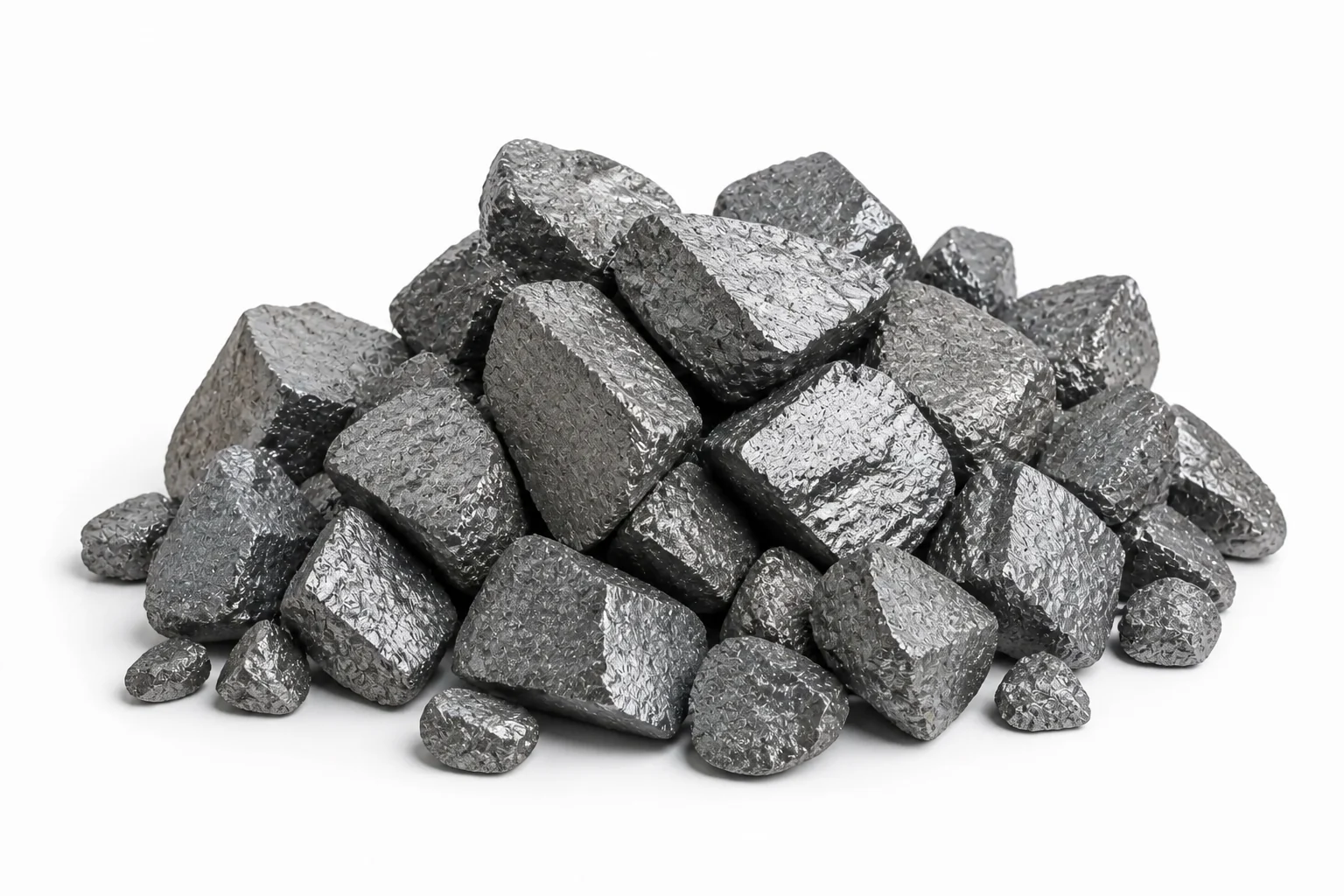
A manganese-silicon-aluminium alloy family bounded by YB/T 4303—2012. After review of the steel grade and deoxidation practice, it may support combined deoxidation and joint Mn/Si/Al adjustment; actual grades, impurities, sizing and supply capability require the company SKU/TDS and lot COA.
Multi-element combined deoxidationJoint Mn/Si/Al adjustmentCoordinated addition-point and recovery management
Key indicatorsMn / Si / Al · C / P / S · Other controlled impurities
Order boundaryQuotation and order confirmation
QUICK DECISION
Four answers before reading the technical detail
This section supports initial screening; final grade, addition and effects require operating conditions, formal documents and plant validation.
01
What it is
A manganese-silicon-aluminium alloy family bounded by YB/T 4303—2012. After review of the steel grade and deoxidation practice, it may support combined deoxidation and joint Mn/Si/Al adjustment; actual grades, impurities, sizing and supply capability require the company SKU/TDS and lot COA.
02
What it does
Multi-element combined deoxidation
Joint Mn/Si/Al adjustment
Coordinated addition-point and recovery management
03
Where it fits
Combined tap deoxidation, ladle alloying or an approved trimming stage
04
Boundary not to miss
A fixed Mn/Si/Al ratio may not match the steel target; excess Al or poor timing may create inclusion and nozzle-clogging risk
SELECTION BOUNDARY
Start with the selection boundary
The formal YB/T 4303 name is manganese-silicon-aluminium alloy; “silicon-aluminium-manganese” is retained only as the user's short name. It is not an automatic substitute for silicomanganese, silicon-aluminium alloy, aluminium-manganese ferroalloy or three separate elemental additions; check Mn/Si/Al targets, C/P/S budget, oxygen potential, slag and casting constraints together.
PRODUCT MANUFACTURING
Product manufacturing process
Manganese-silicon-aluminium alloy (which a supplier may also call silicon-aluminium-manganese ferroalloy) may be produced by a declared co-smelting, remelt-alloying or other controlled route, followed by casting, cooling, crushing, screening, homogenisation and testing. A smelted alloy and a mechanical blend must be managed as different product identities.
01Confirm manganese, silicon and aluminium feeds, iron matrix and any returns
02Use the supplier-declared co-smelting, remelt-alloying or other controlled route
03Control melting, chemical homogeneity, slag entrainment, casting and cooling
04Crush, screen, homogenise and sample representatively
05Test Mn, Si, Al, Fe matrix, accompanying elements, sizing and pack
SPECIFICATIONS & PACKAGING
Grades, specifications, indicators and packaging
The product name is not a complete commercial specification. Purchase documents must fix the formal name and product route, Mn/Si/Al ratio and Fe matrix, plus agreed C, P, S and application-specific impurities, form, sizing, within-lot homogeneity, packing and test methods. No fixed grade values are assumed without a verified TDS.
01Confirm the formal product name, smelted/blended identity and supplier grade
02Check agreed Mn, Si, Al, Fe, C, P, S and other indicators
03Fix sizing, fines, segregation/homogeneity and sampling method
04Confirm pack, moisture control, SDS, label and lot COA
GRADES & SPECIFICATIONS
Grades, specifications, indicators and packaging
Supply specifications, packaging, lead time and quality documents are subject to the formal quotation and order confirmation.
Grade / family
Chemistry
Size and form
Packaging
Specification direction 01Manganese-silicon-aluminium alloyConfirm grade, applicable standard and guaranteed values before quotation
Mn / Si / AlConfirm in inquiry
C / P / SConfirm in inquiry
Other controlled impuritiesConfirm in inquiry
Confirm against the addition method, equipment and order requirements
Confirm pack format, net weight and labels in the quotation and order
ORDER SPECIFICATION CONFIRMATION
What must be confirmed before this becomes an order specification
Supply specifications, packaging, lead time and quality documents are subject to the formal quotation and order confirmation.
01Confirm the product, grade, application and supply scope
02Fix guaranteed chemistry, sizing, form and packing in the quotation and order
03Agree sampling, test methods, acceptance rules and lot COA fields
04Confirm the required TDS, SDS/PSI, labels and delivery documents
SELECTION AND COMPARISON
Compare specification directions by indicators and operating conditions
Supply specifications, packaging, lead time and quality documents are subject to the formal quotation and order confirmation.
01Specification direction
Manganese-silicon-aluminium alloy
Compare the key indicators below, then confirm grade, guaranteed values, sizing and packing against the operating conditions.
Key indicators
Mn / Si / Al · C / P / S · Other controlled impurities
Size and form
Confirm against the addition method, equipment and order requirements
Packaging
Confirm in the quotation and order
INDUSTRY APPLICATION
Industry, furnace, material and addition point
Confirm the process position before method and quantity calculations; an application relationship for one furnace or material must not be copied to another.
01
Steelmaking plants
Combined tap deoxidation, ladle alloying or an approved trimming stage
Furnace / equipment
BOF/EAF tapping, LF/ladle and reviewed secondary-metallurgy routes
Material / output
Steel grades requiring combined deoxidation and coordinated Mn/Si/Al adjustment with defined residual-element and casting constraints
APPLICATION METHOD
Application method and effect validation
For combined deoxidation or multi-element alloying, balance Mn, Si and Al separately. The element that first reaches the grade limit sets the maximum addition, which must be validated against endpoint oxygen, slag condition, temperature, recovery and inclusion-control objectives. This family page provides no fixed addition ratio across steel grades.
01Confirm steel grade, initial and target Mn, Si and Al, and endpoint oxygen
02Complete separate three-element mass balances from measured product values and site recoveries
03Set the addition cap from the limiting element and choose sizing, point and stirring method
04Resample to verify Mn/Si/Al, oxygen, inclusions, dissolution and final performance
PROBLEM AND SOLUTION
From operating objective to effect verification
Each application explains the role, method, quantity principle and risk boundary; the final proposal is confirmed against operating conditions and lot documents.
01
Steelmaking plants
Combined tap deoxidation, ladle alloying or an approved trimming stage
Furnace / equipment
BOF/EAF tapping, LF/ladle and reviewed secondary-metallurgy routes
Material / output
Steel grades requiring combined deoxidation and coordinated Mn/Si/Al adjustment with defined residual-element and casting constraints
Method
Choose grade and addition point from steel O, Mn, Si, Al, temperature, slag and casting route; ensure dryness, dissolution and mixing, then close the loop with steel samples and inclusion/nozzle performance.
Quantity determination
Calculate net Mn, Si and Al needs separately, let the first limiting element set the dose, then check lot-measured chemistry, plant recovery and C/P/S carry-in.
Expected effects
Provides coordinated multi-element addition in a designed deoxidation practice
Limits and risks
A fixed Mn/Si/Al ratio may not match the steel target; excess Al or poor timing may create inclusion and nozzle-clogging risk
STORAGE & SAFETY
Storage, handling and risk
Keep dry and control crushing dust, mix-ups and moisture; follow the actual-SKU SDS/PSI and hot-metal charging procedures.
This section does not replace the company's final SDS/PSI or the plant safety procedure.
REFERENCE AND ORDER BOUNDARY
Use industry references to understand, then order documents to confirm
Supply specifications, packaging, lead time and quality documents are subject to the formal quotation and order confirmation.
DOCUMENTS & MEDIA
Images, TDS, SDS and COA
Document availability depends on the product, lot, destination market and order agreement.
TDS
Confirms product identity, guaranteed indicators, sizing, form and packing.
SDS / PSI
Confirms storage, handling, protection and market-specific safety information.
COA
Links a specific lot to test items, results, methods and issue information.
INDUSTRY TECHNICAL REFERENCES
Selected external reference material
The following items come from licensed public media or original producer websites and explain similar products or typical processes only. They are not Jinsheng photographs, TDS, SDS or lot COA and create no supply commitment.
Blank COA template
COA field template (not a certificate)
A blank structure for lot, chemistry, sizing, method, disposition and issue data. It contains no test result and cannot be used for delivery.
01Target industry, steel grade or casting material
02Furnace type, equipment, melt weight and current operating practice
03Measured chemistry, target chemistry and permitted residuals
04Planned addition point, temperature, slag and stirring conditions
05Current product, addition, recovery or operating-issue record
06Required size, form, packaging, quantity and destination
07Available melt analysis, microscopy, photographs or trial results
TECHNICAL AND QUOTATION CONSULTATION
Send the operating conditions for human review
Domestic inquiries are handled by the Domestic Sales Department and international inquiries by the International Sales Department. Price, availability and lead time are confirmed for each inquiry based on specification, quantity and delivery location.