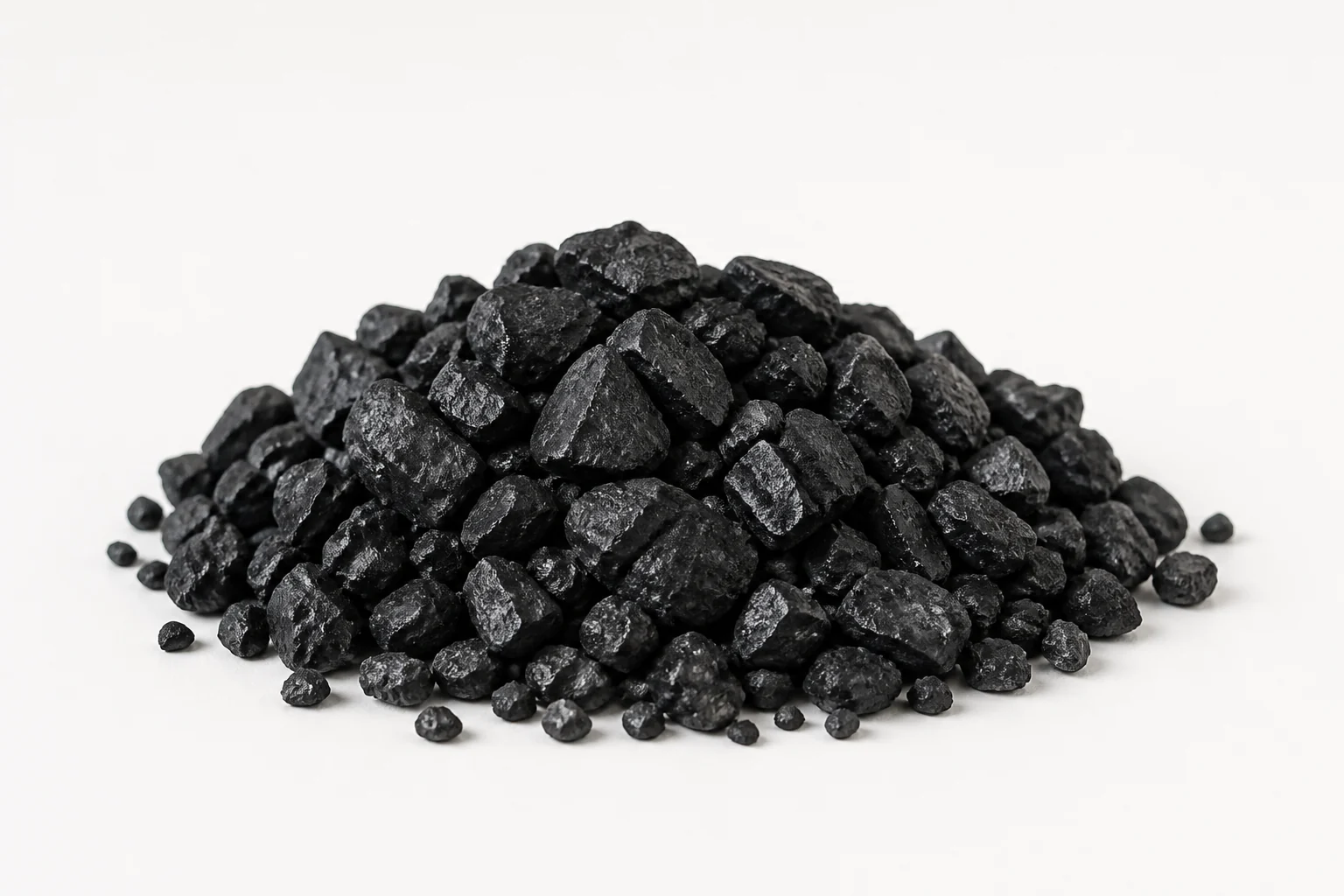
This page explains the product's principal composition, application directions and inquiry points; confirm the grade, guaranteed indicators, sizing, packing and process fit before quotation.
Steel / iron recarburizingCharge-carbon balanceValidated carbon-source selection
Key indicatorsCoal source / GCA or ECA / calcination state · Fixed C / ash / volatile matter / moisture · S / N / H / P / trace elements · Bulk density / dissolution / absorption
Order boundaryQuotation and order confirmation
QUICK DECISION
Four answers before reading the technical detail
This section supports initial screening; final grade, addition and effects require operating conditions, formal documents and plant validation.
01
What it is
This page explains the product's principal composition, application directions and inquiry points; confirm the grade, guaranteed indicators, sizing, packing and process fit before quotation.
02
What it does
Steel / iron recarburizing
Charge-carbon balance
Validated carbon-source selection
03
Where it fits
Charging and melting; only validated small corrections before tapping
Charging and melting with sufficient time for dissolution and resampling
Charging or melting; not a default ladle-trimming material
04
Boundary not to miss
Ash, S/N, coal-source variation, under-calcination, slow dissolution or excess fines may increase slag, porosity, inclusions and absorption variation
High-cleanliness, ultra-low-S/P/N or gas-sensitive grades must not use it without trials
Ash, sulfur/nitrogen and coal-source consistency may fail steel cleanliness or chemistry budgets
SELECTION BOUNDARY
Start with the selection boundary
Similar names, forms or uses do not make products interchangeable; confirm product identity, specification, application process and order documents separately.
PRODUCT MANUFACTURING
Manufacturing process and identity boundary
Calcined-anthracite recarburizer is made from verified anthracite by controlled gas-fired or electrically heated calcining, followed by cooling, crushing/screening, product homogenisation, sampling/testing and protected packing. GCA and ECA identify different routes; coal source, equipment, thermal schedule, fuel and calcination state belong to the actual supplier's files, and the page assumes neither one universal route nor Jinsheng-owned production.
01Verify anthracite source, lot, coal quality, ash/S/N and foreign matter
02Confirm GCA or ECA identity and calcine under supplier documents
03Cool under control and prevent moisture pickup, raw-coal and other-carbon mixing
04Crush, screen, remove abnormal fines and homogenise by SKU
05Sample and test calcination state, chemistry, sizing and properties, then pack against moisture
SPECIFICATIONS & PACKAGING
Grades, RFQ parameters, indicators and documents
An RFQ must state GCA/ECA, coal source, fixed carbon, ash, volatiles, moisture, S/N/H/P and trace elements, full sizing, fines/oversize, bulk density, calcination state and furnace-specific dissolution/absorption validation. CAC is easily confused with calcium aluminate cement, so the full name should be used in orders, labels and codes.
01Confirm GCA/ECA and coal source with the full name; do not order under the bare acronym CAC
02Agree fixed carbon, ash, volatiles, moisture and S/N/H/P/trace elements
03Agree size distribution, fines, oversize, bulk density and sampling method
04Define calcination state, dissolution/absorption test and lot consistency in the contract
05Reconcile TDS, SDS/PSI, lot COA, pack and source traceability
GRADES & SPECIFICATIONS
Grades, specifications, indicators and packaging
Supply specifications, packaging, lead time and quality documents are subject to the formal quotation and order confirmation.
Grade / family
Chemistry
Size and form
Packaging
Specification direction 01Calcined anthracite recarburizerConfirm grade, applicable standard and guaranteed values before quotation
Coal source / GCA or ECA / calcination stateConfirm in inquiry
Fixed C / ash / volatile matter / moistureConfirm in inquiry
S / N / H / P / trace elementsConfirm in inquiry
Bulk density / dissolution / absorptionConfirm in inquiry
Confirm against the addition method, equipment and order requirements
Confirm pack format, net weight and labels in the quotation and order
ORDER SPECIFICATION CONFIRMATION
What must be confirmed before this becomes an order specification
Supply specifications, packaging, lead time and quality documents are subject to the formal quotation and order confirmation.
01Confirm the product, grade, application and supply scope
02Fix guaranteed chemistry, sizing, form and packing in the quotation and order
03Agree sampling, test methods, acceptance rules and lot COA fields
04Confirm the required TDS, SDS/PSI, labels and delivery documents
SELECTION AND COMPARISON
Compare specification directions by indicators and operating conditions
Supply specifications, packaging, lead time and quality documents are subject to the formal quotation and order confirmation.
01Specification direction
Calcined anthracite recarburizer
Compare the key indicators below, then confirm grade, guaranteed values, sizing and packing against the operating conditions.
Key indicators
Coal source / GCA or ECA / calcination state · Fixed C / ash / volatile matter / moisture · S / N / H / P / trace elements · Bulk density / dissolution / absorption
Size and form
Confirm against the addition method, equipment and order requirements
Packaging
Confirm in the quotation and order
INDUSTRY APPLICATION
Industry, furnace, material and addition point
Confirm the process position before method and quantity calculations; an application relationship for one furnace or material must not be copied to another.
01
Iron foundries
Charging and melting; only validated small corrections before tapping
Furnace / equipment
Coreless induction furnaces and validated duplex-melting routes
Material / output
Grey iron; ductile iron/CGI only with low-residual product validated for S/N/H and nodularisation risk
02
Steel foundries
Charging and melting with sufficient time for dissolution and resampling
Furnace / equipment
EAF or validated coreless induction furnace
Material / output
Cast steel whose ash, sulfur, nitrogen and other residual budgets permit the coal source
03
Steelmaking plants
Charging or melting; not a default ladle-trimming material
Furnace / equipment
Electric-furnace routes jointly approved by supplier and steel plant
Material / output
Steel grades whose residual, ash and cleanliness budgets permit the product
APPLICATION METHOD
Application, calculation, effect and risk validation
Calcined anthracite may recarburize with the charge or during melting in validated cast-iron induction furnaces, cast steel or selected electric-steel routes. Its absorption cannot be copied from GPC/CPC; ductile iron, CGI, high-cleanliness or gas-sensitive metal requires separate review for ash, S/N/H and source variability.Use decimal mass fractions for the starting estimate: ⟦m_add(kg) ≈ M_melt(t) × 1,000 × Δw_C ÷ (w_C,product × η_C)⟧. Δw_C must deduct charge-carbon carry-in and predicted oxidation/decarburisation; w_C,product comes from the actual lot; η_C must come from a site trial on the same furnace, sizing and addition point. The equation does not replace heat-by-heat resampling or create a fixed kg/t commitment.
01Confirm furnace, metal grade, charge carbon and ash/S/N/H/cleanliness budgets
02Make the starting mass balance from the actual GCA/ECA lot and furnace-history η_C
03Layer with metallic charge or add at the approved melting point to promote wetting and stirring
04Allow dissolution time, resample C/S/N and observe slag, porosity and microstructure
05Maintain absorption and stop criteria separately by source and route without cross-product borrowing
PROBLEM AND SOLUTION
From operating objective to effect verification
Each application explains the role, method, quantity principle and risk boundary; the final proposal is confirmed against operating conditions and lot documents.
01
Iron foundries
Charging and melting; only validated small corrections before tapping
Furnace / equipment
Coreless induction furnaces and validated duplex-melting routes
Material / output
Grey iron; ductile iron/CGI only with low-residual product validated for S/N/H and nodularisation risk
Method
Layer appropriately with metallic charge and ensure wetting, dissolution and stirring; establish a separate practice from coal source, sizing and furnace-specific absorption.
Quantity determination
Use decimal mass fractions consistently. General estimate: ⟦m_add(kg) ≈ M_melt(t) × 1,000 × Δw_C ÷ (w_C,product × η_C)⟧. Δw_C is the net carbon increase still required after charge-carbon carry-in and predicted oxidation/decarburisation; enter product carbon fraction w_C,product and the measured furnace-, size- and stage-specific carbon absorption η_C as decimals. The equation is only a starting estimate; heat-by-heat sampling and plant trials must correct the amount.
Expected effects
Corrects carbon and carbon equivalent within a validated charge and residual window
Limits and risks
Ash, S/N, coal-source variation, under-calcination, slow dissolution or excess fines may increase slag, porosity, inclusions and absorption variation
02
Steel foundries
Charging and melting with sufficient time for dissolution and resampling
Furnace / equipment
EAF or validated coreless induction furnace
Material / output
Cast steel whose ash, sulfur, nitrogen and other residual budgets permit the coal source
Method
Calculate from the charge-carbon deficit and measured furnace absorption; avoid strong oxidation, flotation and large late additions.
Quantity determination
Use decimal mass fractions consistently. General estimate: ⟦m_add(kg) ≈ M_melt(t) × 1,000 × Δw_C ÷ (w_C,product × η_C)⟧. Δw_C is the net carbon increase still required after charge-carbon carry-in and predicted oxidation/decarburisation; enter product carbon fraction w_C,product and the measured furnace-, size- and stage-specific carbon absorption η_C as decimals. The equation is only a starting estimate; heat-by-heat sampling and plant trials must correct the amount.
Expected effects
Closes the carbon deficit confirmed by mass balance
Limits and risks
High-cleanliness, ultra-low-S/P/N or gas-sensitive grades must not use it without trials
03
Steelmaking plants
Charging or melting; not a default ladle-trimming material
Furnace / equipment
Electric-furnace routes jointly approved by supplier and steel plant
Material / output
Steel grades whose residual, ash and cleanliness budgets permit the product
Method
Establish the practice from the actual GCA/ECA grade, sizing, slag oxidation and delivery method; do not transfer cast-iron assumptions directly to steelmaking.
Quantity determination
Use decimal mass fractions consistently. General estimate: ⟦m_add(kg) ≈ M_melt(t) × 1,000 × Δw_C ÷ (w_C,product × η_C)⟧. Δw_C is the net carbon increase still required after charge-carbon carry-in and predicted oxidation/decarburisation; enter product carbon fraction w_C,product and the measured furnace-, size- and stage-specific carbon absorption η_C as decimals. The equation is only a starting estimate; heat-by-heat sampling and plant trials must correct the amount.
Expected effects
Corrects charge-carbon balance in approved steel grades
Limits and risks
Ash, sulfur/nitrogen and coal-source consistency may fail steel cleanliness or chemistry budgets
STORAGE & SAFETY
Storage, handling and risk
Protect strictly from moisture and segregate from uncalcined coal, coke and other carbons; lot identity cannot be judged by appearance alone.
Fines are combustible dust; manage enclosed transfer, extraction, static and ignition sources under the final SDS/PSI.
This section does not replace the company's final SDS/PSI or the plant safety procedure.
REFERENCE AND ORDER BOUNDARY
Use industry references to understand, then order documents to confirm
Supply specifications, packaging, lead time and quality documents are subject to the formal quotation and order confirmation.
DOCUMENTS & MEDIA
Images, TDS, SDS and COA
Document availability depends on the product, lot, destination market and order agreement.
TDS
Confirms product identity, guaranteed indicators, sizing, form and packing.
SDS / PSI
Confirms storage, handling, protection and market-specific safety information.
COA
Links a specific lot to test items, results, methods and issue information.
INDUSTRY TECHNICAL REFERENCES
Selected external reference material
The following items come from licensed public media or original producer websites and explain similar products or typical processes only. They are not Jinsheng photographs, TDS, SDS or lot COA and create no supply commitment.
Blank COA template
COA field template (not a certificate)
A blank structure for lot, chemistry, sizing, method, disposition and issue data. It contains no test result and cannot be used for delivery.
01Target industry, steel grade or casting material
02Furnace type, equipment, melt weight and current operating practice
03Measured chemistry, target chemistry and permitted residuals
04Planned addition point, temperature, slag and stirring conditions
05Current product, addition, recovery or operating-issue record
06Required size, form, packaging, quantity and destination
07Available melt analysis, microscopy, photographs or trial results
TECHNICAL AND QUOTATION CONSULTATION
Send the operating conditions for human review
Domestic inquiries are handled by the Domestic Sales Department and international inquiries by the International Sales Department. Price, availability and lead time are confirmed for each inquiry based on specification, quantity and delivery location.