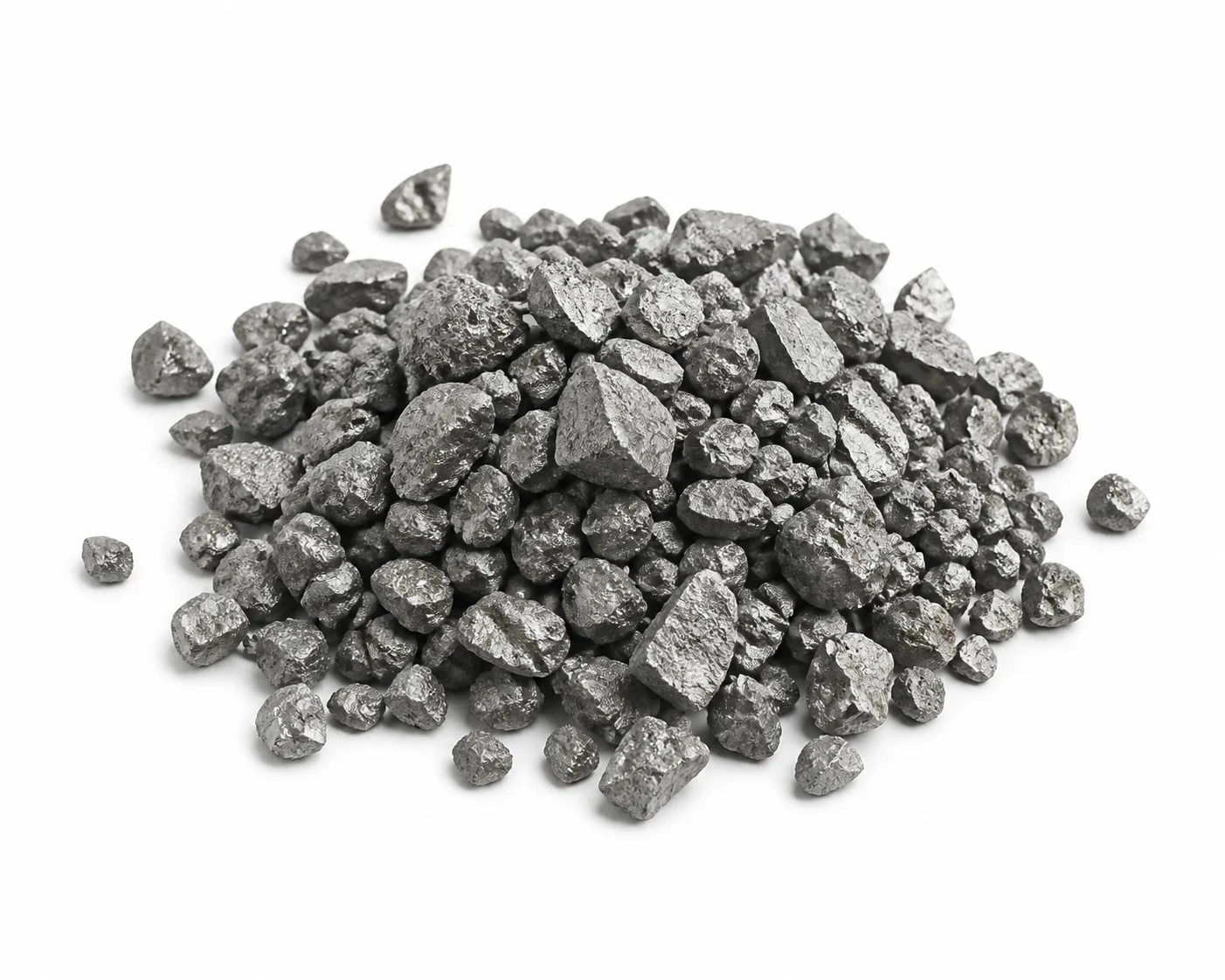
This page explains the product's principal composition, application directions and inquiry points; confirm the grade, guaranteed indicators, sizing, packing and process fit before quotation.
Promote graphite nucleationReduce undercooling and chillStabilise microstructure
Key indicatorsSi / Al / Ca · Active elements / residuals · Si carrier · Ca / Ba / Sr / Zr / RE / Bi / others
Order boundaryQuotation and order confirmation
QUICK DECISION
Four answers before reading the technical detail
This section supports initial screening; final grade, addition and effects require operating conditions, formal documents and plant validation.
01
What it is
This page explains the product's principal composition, application directions and inquiry points; confirm the grade, guaranteed indicators, sizing, packing and process fit before quotation.
02
What it does
Promote graphite nucleation
Reduce undercooling and chill
Stabilise microstructure
03
Where it fits
Ladle or in-stream inoculation, as close to pouring as practical
Post-inoculation after nodularising, in ladle or stream
Controlled inoculation after CGI treatment
04
Boundary not to miss
Early addition can suffer inoculation fade
An unsuitable active-element system, size or dose can cause undissolved particles, inclusions or insufficient effect
Excess or incompatible chemistry can increase slag, defects or structural variation
SELECTION BOUNDARY
Start with the selection boundary
First identify grey, ductile or CGI, then select active-element system and size from section thickness, cooling rate, base chemistry and addition equipment. Families include Ca-Ba, Sr, Zr, Sr-Zr, RE, Bi and Ca-Al; only company-approved actual offerings may become formal SKUs.
PRODUCT MANUFACTURING
Product manufacturing process
Silicon-based inoculants may be ordinary ferrosilicon intended for inoculation or FeSi-based compound systems with controlled Ca, Ba, Sr, Zr, RE or Bi. Formula and active-element control are generally supplier-specific.
01Inspect FeSi base and active-element feeds
02Controlled melting/formulation and homogenisation
03Cast, cool and crush
04Narrow sizing and fines removal
05Test active elements, size and lot
SPECIFICATIONS & PACKAGING
Grades, specifications, indicators and packaging
Create SKUs by active-element system, Si/Al/Ca indicators and ladle/stream sizing; a family framework is not a company stock grade.
01Confirm grey, ductile or validated CGI
02Select Ca/Ba/Sr/Zr/RE/Bi system
03Match size to ladle or stream inoculation
04Confirm actual company grade and pack
GRADES & SPECIFICATIONS
Grades, specifications, indicators and packaging
Supply specifications, packaging, lead time and quality documents are subject to the formal quotation and order confirmation.
Grade / family
Chemistry
Size and form
Packaging
Specification direction 01FeSi-based inoculantConfirm grade, applicable standard and guaranteed values before quotation
Si / Al / CaConfirm in inquiry
Active elements / residualsConfirm in inquiry
Confirm against the addition method, equipment and order requirements
Confirm pack format, net weight and labels in the quotation and order
Specification direction 02FeSi-based inoculantConfirm grade, applicable standard and guaranteed values before quotation
Si carrierFeSi-based
Ca / Ba / Sr / Zr / RE / Bi / othersConfirm in inquiry
Al / Ti / residualsControlled by material grade and defect risk
Confirm against the addition method, equipment and order requirements
Confirm pack format, net weight and labels in the quotation and order
ORDER SPECIFICATION CONFIRMATION
What must be confirmed before this becomes an order specification
Supply specifications, packaging, lead time and quality documents are subject to the formal quotation and order confirmation.
01Confirm the product, grade, application and supply scope
02Fix guaranteed chemistry, sizing, form and packing in the quotation and order
03Agree sampling, test methods, acceptance rules and lot COA fields
04Confirm the required TDS, SDS/PSI, labels and delivery documents
SELECTION AND COMPARISON
Compare specification directions by indicators and operating conditions
Supply specifications, packaging, lead time and quality documents are subject to the formal quotation and order confirmation.
01Specification direction
FeSi-based inoculant
Compare the key indicators below, then confirm grade, guaranteed values, sizing and packing against the operating conditions.
Key indicators
Si / Al / Ca · Active elements / residuals
Size and form
Confirm against the addition method, equipment and order requirements
Packaging
Confirm in the quotation and order
02Specification direction
FeSi-based inoculant
Compare the key indicators below, then confirm grade, guaranteed values, sizing and packing against the operating conditions.
Key indicators
Si carrier · Ca / Ba / Sr / Zr / RE / Bi / others · Al / Ti / residuals
Size and form
Confirm against the addition method, equipment and order requirements
Packaging
Confirm in the quotation and order
INDUSTRY APPLICATION
Industry, furnace, material and addition point
Confirm the process position before method and quantity calculations; an application relationship for one furnace or material must not be copied to another.
01
Iron foundries
Ladle or in-stream inoculation, as close to pouring as practical
Furnace / equipment
Liquid iron from cupola, induction or duplex melting
Material / output
Grey cast iron
02
Iron foundries
Post-inoculation after nodularising, in ladle or stream
Furnace / equipment
Nodularised iron from the applicable melting route
Material / output
Ductile cast iron
03
Iron foundries
Controlled inoculation after CGI treatment
Furnace / equipment
Validated CGI treatment route
Material / output
Compacted graphite iron (CGI)
APPLICATION METHOD
Application method and effect validation
Inoculation is generally close to pouring and selected against base iron, section thickness and fade time. Furnace FeSi adjustment and pre-pour inoculation are different product scenarios.
01Confirm iron type, base-iron S/O and thermal analysis
The public external reference helps explain a similar product or typical process; it is not evidence of a Jinsheng-owned line, stock or customer site.
PROBLEM AND SOLUTION
From operating objective to effect verification
Each application explains the role, method, quantity principle and risk boundary; the final proposal is confirmed against operating conditions and lot documents.
01
Iron foundries
Ladle or in-stream inoculation, as close to pouring as practical
Furnace / equipment
Liquid iron from cupola, induction or duplex melting
Material / output
Grey cast iron
Method
Similar names, forms or uses do not make products interchangeable; confirm product identity, specification, application process and order documents separately.
Quantity determination
Determine from carbon equivalent, S/O condition, base-iron nucleation, pouring temperature, fade time, section thickness, cooling rate and thermal-analysis/trial results.
Expected effects
Increases nucleation and reduces chill/carbides
Improves flake graphite and structural consistency
Limits and risks
Early addition can suffer inoculation fade
An unsuitable active-element system, size or dose can cause undissolved particles, inclusions or insufficient effect
02
Iron foundries
Post-inoculation after nodularising, in ladle or stream
Furnace / equipment
Nodularised iron from the applicable melting route
Material / output
Ductile cast iron
Method
Re-inoculate after nodularising and control the inoculation-to-pour time; nodularizer does not replace post-inoculant.
Quantity determination
Set from post-treatment iron condition, residual Mg, section thickness, target nodule count and fade time using thermal analysis, microscopy and trials.
Expected effects
Raises nodule count and reduces chill/carbides
Limits and risks
Excess or incompatible chemistry can increase slag, defects or structural variation
03
Iron foundries
Controlled inoculation after CGI treatment
Furnace / equipment
Validated CGI treatment route
Material / output
Compacted graphite iron (CGI)
Method
Validate as a system with the CGI treatment alloy, thermal analysis and residual-Mg control; do not directly transfer grey- or ductile iron practice.
Quantity determination
Determine from the narrow residual-Mg window, S/O condition, section thickness and CGI-rate feedback.
Expected effects
Supports uniform compacted graphite and suppresses carbides
Limits and risks
Incorrect inoculation intensity can alter graphite form and requires plant-specific validation
STORAGE & SAFETY
Storage, handling and risk
Keep dry and minimise degradation; wet material and fines present splash, dust and reaction hazards in molten iron.
Bi, Sb, B, RE and other active-element systems require review against final chemistry, microscopy and defect risk.
This section does not replace the company's final SDS/PSI or the plant safety procedure.
REFERENCE AND ORDER BOUNDARY
Use industry references to understand, then order documents to confirm
Supply specifications, packaging, lead time and quality documents are subject to the formal quotation and order confirmation.
DOCUMENTS & MEDIA
Images, TDS, SDS and COA
Document availability depends on the product, lot, destination market and order agreement.
TDS
Confirms product identity, guaranteed indicators, sizing, form and packing.
SDS / PSI
Confirms storage, handling, protection and market-specific safety information.
COA
Links a specific lot to test items, results, methods and issue information.
INDUSTRY TECHNICAL REFERENCES
Selected external reference material
The following items come from licensed public media or original producer websites and explain similar products or typical processes only. They are not Jinsheng photographs, TDS, SDS or lot COA and create no supply commitment.
Published producer video
Published ductile iron melting and treatment video
An Elkem-published ductile iron production and melt-treatment video for understanding addition stages; not a Jinsheng customer site.
Public sources supplement general facts; they do not replace Jinsheng's formal product specification, TDS or lot COA.
INQUIRY PREPARATION
Prepare these operating conditions for a more precise technical response
Please provide the specification, quantity, destination, and contact information.
Already includedFD-INOC-FESIFeSi-based inoculant
01Target industry, steel grade or casting material
02Furnace type, equipment, melt weight and current operating practice
03Measured chemistry, target chemistry and permitted residuals
04Planned addition point, temperature, slag and stirring conditions
05Current product, addition, recovery or operating-issue record
06Required size, form, packaging, quantity and destination
07Available melt analysis, microscopy, photographs or trial results
TECHNICAL AND QUOTATION CONSULTATION
Send the operating conditions for human review
Domestic inquiries are handled by the Domestic Sales Department and international inquiries by the International Sales Department. Price, availability and lead time are confirmed for each inquiry based on specification, quantity and delivery location.